Where Smart Investments Begin
20 Jun, 2026


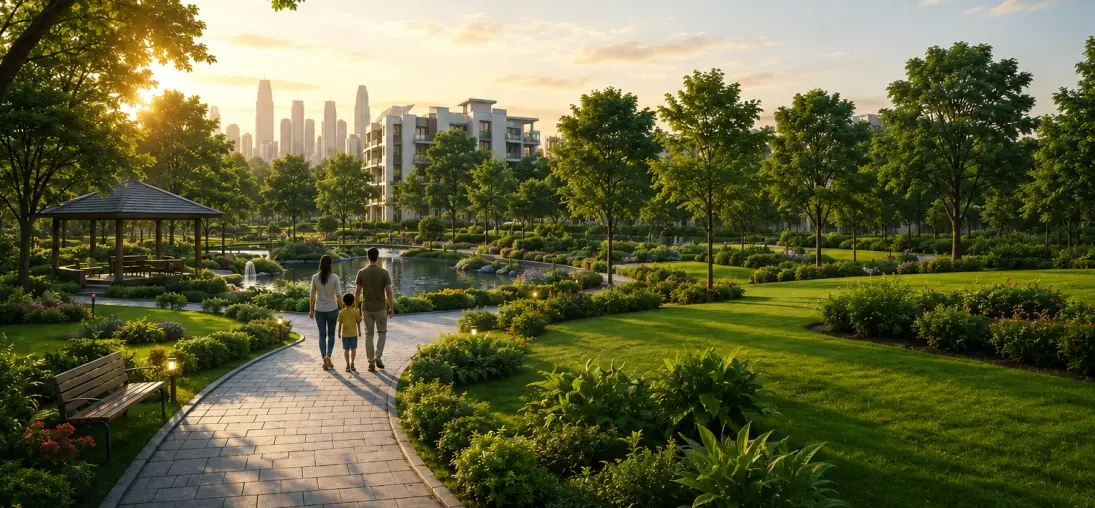
Sustainability in real estate is often reduced to a few familiar words: green spaces, solar power, rainwater harvesting and energy efficiency. But a genuinely sustainable residential community is more comprehensive.
It considers how a site is planned, how much water a building consumes, how efficiently it uses energy, how residents experience indoor spaces, how waste is handled and how the development interacts with its surrounding environment.
For homebuyers, sustainability is therefore not only an environmental issue. It can also influence comfort, operating costs, health and long-term liveability.
Buildings consume significant quantities of energy and water throughout their life. The Indian Green Building Council’s Green Homes programme is specifically designed for residential buildings and addresses areas including site planning, water conservation, energy efficiency, materials and resources, indoor environmental quality, and innovation.
That framework reflects an important shift in the industry: sustainability is no longer just about adding greenery after construction. It is increasingly about integrating environmental performance into the design of the home itself.
The first sustainable decision is often the location and site plan. A development that is close to workplaces, schools, public transport and everyday services can reduce the distance residents need to travel. Walkable internal planning, shaded pathways, landscaping and thoughtful open spaces can also make a community more comfortable.
Bengaluru is continuing to expand its public transport infrastructure, with multiple Metro corridors being developed and upgraded. As connectivity improves, the relationship between housing, transport and urban planning becomes increasingly important.
Sustainable development therefore begins with a simple question:
How well does the community fit into the city around it?
Residential communities depend heavily on water—for drinking, bathing, cleaning, landscaping and common facilities. Responsible development can reduce pressure on freshwater resources through rainwater harvesting, efficient fixtures, wastewater treatment, reuse where appropriate and landscape planning that avoids unnecessary consumption.
IGBC’s Green Homes framework identifies water conservation as a core category and notes that green residential design can reduce water consumption significantly.
Its published benefits indicate potential water savings of approximately 30–50% in qualifying green-home approaches, depending on the measures adopted and project performance. The exact result will vary by project, occupancy and systems, so buyers should look for actual specifications rather than broad sustainability claims.
The cheapest unit of energy is often the one that does not need to be consumed. Orientation, shading, glazing, insulation, daylight, ventilation and efficient lighting can all influence a building’s energy demand.
Natural light is particularly important because it can reduce dependence on artificial lighting during daylight hours while also improving the character of indoor spaces.
The National Building Code includes provisions covering lighting, natural ventilation and sustainability, reflecting the importance of integrating these considerations into building design.
A sustainable home should also be a comfortable home. Natural ventilation can help move warm air out and bring fresh outdoor air in when outdoor conditions are suitable.
WHO notes that improved ventilation can increase air exchange and air quality, while natural ventilation can also contribute to cooling and potentially reduce energy use under appropriate conditions. However, ventilation needs to be designed intelligently.
Outdoor pollution, noise, heat and security conditions all matter. The goal is not simply to open more windows. It is to create a building that manages airflow, daylight, heat and indoor comfort thoughtfully.
Landscaping should not be treated as decoration alone. Trees and vegetation can create shade, improve the visual environment and provide residents with places to pause, walk and spend time outdoors.
For children, older residents and families, accessible green areas can contribute to the everyday experience of a community.
Bengaluru’s continuing efforts to expand and protect urban green infrastructure demonstrate the wider importance of balancing rapid development with liveable public environments.
Recent state plans have included proposals for additional botanical gardens as part of the city’s broader green-space strategy. Within a residential development, the same principle applies at a smaller scale: open spaces should be purposeful, accessible and integrated into the way residents actually use the community.
Sustainable construction also involves thinking about materials. The National Building Code addresses building materials, construction practices, waste management and the use of alternative materials.
It also recognises the potential for incorporating construction and demolition waste into building applications without compromising quality and safety.
For developers, responsible material selection can involve durability, local availability, resource intensity, maintenance requirements and end-of-life considerations.
For buyers, the practical question is:
Does the material choice make the building more durable, efficient or easier to maintain?
Waste management should be designed into a residential community that generates waste every day. That makes segregation, collection, treatment and disposal an important part of sustainable community planning.
The National Building Code specifically includes solid-waste management within its building-services provisions.
Good waste management is not glamorous, but it is one of the clearest indicators that sustainability has been considered as part of the operating life of a project rather than merely as a marketing theme.
There is also a financial dimension.
Energy-efficient lighting, water-saving fixtures, efficient systems and appropriate landscaping can potentially reduce operating requirements.
IGBC cites energy savings of around 20–30% and water savings of around 30–50% for Green Homes, alongside benefits such as improved daylighting, air quality and occupant wellbeing.
Actual performance depends on project design, systems, usage and maintenance. This is why sustainability should be understood as a long-term operating strategy, not simply an environmental statement.
Homebuyers should be careful with vague sustainability claims.
Ask:
Specific answers are more useful than adjectives.
A sustainable home is not merely one that consumes fewer resources. It should also be a place where people can breathe comfortably, receive natural light, access greenery, move safely and enjoy a healthy indoor and outdoor environment.
WHO’s housing guidance emphasises that improved housing conditions can contribute to health, quality of life and climate resilience. That makes sustainability deeply human.
It is about creating communities that function better today without placing unnecessary pressure on tomorrow.
The most meaningful sustainable developments do not ask residents to sacrifice comfort for environmental responsibility. Instead, they integrate both.
Thoughtful orientation can improve daylight. Good ventilation can improve comfort. Efficient fixtures can reduce water use. Landscaping can create shade and amenity. Better materials can improve durability. Good connectivity can reduce unnecessary travel.
The result is a community that is not only more responsible but also more pleasant to live in.
That is the real promise of sustainable residential development: a better relationship between the home, the resident and the environment around them.