Thoughtfully Designed Spaces for Modern Living
14 Jun, 2026


A home is private.
A community is shared.
That distinction is becoming increasingly important in residential real estate. Buyers no longer evaluate an apartment only by its carpet area, number of bedrooms or kitchen specification. They also want to understand what life will feel like once they step outside the front door.
Will children have somewhere safe to play?
Can residents walk comfortably?
Are there places to sit, exercise or meet neighbours?
Is there enough greenery?
Are common spaces thoughtfully planned?
The answers can shape the quality of life just as much as the apartment itself.
Residential developments work best when individual homes and shared spaces complement one another.
The National Building Code recognises the importance of the broader built environment, covering areas including accessibility, landscape development, parking, fire and life safety, building services and facility management.
This is important because a residential community is not simply a collection of buildings.
It is a system of spaces, movement, services and relationships.
Green space is valuable, but simply calculating the percentage of open area does not tell the entire story.
A well-planned open space should be usable.
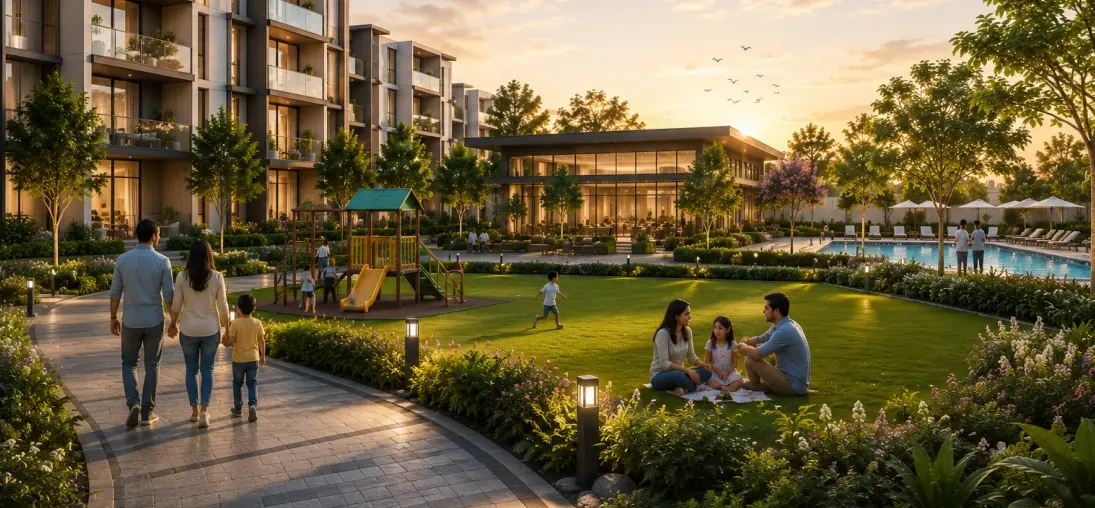
It could provide a shaded walking route, a children's play area, a garden, a seating zone or a quiet place for residents to spend time outdoors.
Landscape planning can also influence microclimate, visual comfort and the identity of a community.
In a rapidly growing city such as Bengaluru, this becomes particularly relevant as public and private efforts increasingly focus on preserving and expanding urban greenery. Recent state proposals for additional botanical gardens illustrate the wider importance being placed on urban green infrastructure.
A community designed for families should think beyond installing a few play structures.
Children benefit from spaces that are visible, accessible and appropriately separated from vehicle movement.
The relationship between play areas, landscape, seating and pedestrian paths matters.
Parents should be able to supervise children without needing to remain physically inside the play zone.
Good community design therefore creates opportunities for children to play while allowing adults to remain comfortable nearby.
Pedestrian-friendly design can make a development feel more social.
A shaded pathway can encourage residents to walk after dinner. A landscaped route can turn a short journey to the clubhouse into an enjoyable part of the day.
This matters because not every community interaction needs to happen inside an amenity building.
Sometimes it happens while walking.
Sometimes it happens in the garden.
Sometimes two neighbours meet near the entrance and stop for a conversation.
The physical environment can either encourage these small interactions or eliminate them.
Modern residential projects can include extensive amenity lists.
But the most useful amenities are those residents genuinely incorporate into their routines.
A gym should be accessible and functional.
A swimming pool should be appropriately maintained.
A clubhouse should provide spaces people can actually use.
Children’s areas should be safe and engaging.
Senior-friendly seating and walking areas can support multi-generational households.
The objective should not be to create the longest amenity brochure.
It should be to create the most useful everyday environment.
A good residential community reduces friction.
Well-planned parking reduces daily stress.
Clear pedestrian movement improves safety.
Reliable water and power systems provide confidence.
Waste management keeps shared spaces cleaner.
Security and controlled access create reassurance.
Thoughtful service access can prevent maintenance activity from disrupting residents.
These details may not always appear in promotional imagery, but they influence daily satisfaction.
People naturally gather when the environment gives them a reason to.
A landscaped seating area can encourage informal conversations.
A community hall can host birthdays and celebrations.
A multipurpose space can support fitness sessions, workshops or resident meetings.
A children's zone can create opportunities for parents to meet.
The important point is that community should not be forced.
It should be enabled through design.
Creating a connected community does not mean eliminating privacy.
A successful development needs both.
Residents should be able to interact when they choose and retreat when they want.
This can be achieved through the positioning of homes, landscape buffers, building orientation, balcony placement and zoning of shared spaces.
The best communities offer a rhythm between social activity and personal quiet.
Environmental responsibility also has a community dimension.
Water conservation, waste segregation, green landscapes and energy-efficient systems can reduce resource consumption while improving the quality of shared spaces.
IGBC’s residential sustainability framework addresses water, energy, materials, indoor environmental quality and site planning precisely because these factors influence both environmental performance and occupant wellbeing.
Natural ventilation and daylight also contribute to healthier and more comfortable homes. WHO highlights the importance of ventilation, natural light and appropriate housing conditions in supporting wellbeing.
Sustainability, therefore, is not separate from community design.
It is part of it.
A community can be beautifully designed and still feel inconvenient if it is disconnected from the city.
This is why location remains fundamental.
Schools, hospitals, workplaces, shopping, public transport and recreational destinations influence everyday routines.
Bengaluru’s expanding employment ecosystem and infrastructure network make connectivity particularly important. CBRE’s recent office-market data continues to show Bengaluru as a major national employment and corporate hub, with GCCs remaining an important demand driver.
A good community therefore needs to work at two scales:
Inside the development,
and
Within the city.
A residential project is not finished when the developer hands over the keys.
It enters its next chapter.
Landscapes mature. Children grow. Residents form associations. Amenities require maintenance. Common areas need upkeep. Systems need servicing.
The long-term quality of a community therefore depends partly on how well it has been designed for management and maintenance.
Facility management is included within the National Building Code’s broader framework, reinforcing the idea that building performance continues beyond construction.
This is especially important for buyers considering a property as a long-term home.
There is also an emotional dimension to community living.
A house becomes a home through the life that happens inside it.
A residential community becomes meaningful through the people and memories that accumulate around it.
Children grow up knowing the neighbours.
Families celebrate festivals together.
Residents meet during evening walks.
Older people find familiar faces in shared spaces.
These experiences cannot be manufactured through a brochure, but good design can create the conditions in which they happen naturally.
When visiting a residential project, spend some time looking beyond the model apartment.
Most importantly, imagine living there on an ordinary Tuesday—not just during a launch event.
As Bengaluru grows, the definition of a good home will continue to evolve.
People will still care about location, price, size and specifications.
But they will increasingly care about the experience surrounding the front door.
The strongest communities will combine privacy with connection, convenience with calm, architecture with landscape, and contemporary living with responsible planning.
Because ultimately, the best residential development does not simply answer the question:
“Where will I live?”
It answers something more meaningful:
“What kind of life will I live here?”
That is where real community begins.